
The forward view: bulkers & tankers
The forward call
West Africa looks set to remain the fastest growing long-haul source of dry bulk cargo. The region's dry bulk exports reached 202 Mt in 2025, up from 114 Mt in 2022, and shipments in January to August 2026 are running about 25% ahead of last year. Our forecast has exports at around 267 Mt in 2027 and 303 Mt by 2030, with Simandou iron ore more than offsetting slower bauxite. Projects under review could add a further 35 Mt by 2030.
The tonnes understate the shipping impact. Almost every cargo goes to China and almost nothing comes back, so each added tonne ties up a Capesize for a long laden leg and an equally long ballast leg. In our view that makes West Africa one of the largest sources of Capesize demand growth to 2030.
Where things stand now
The four main exporters loaded 160 Mt of their main cargoes in January to August 2026, up 25% on the same months of 2025. Guinea bauxite and Liberian iron ore did most of the lifting.
| Exporter and cargo | Jan to Aug 2025 (Mt) | Jan to Aug 2026 (Mt) | Change |
|---|---|---|---|
| Guinea, bauxite and ores (Capesize) | 107.4 | 126.9 | +18% |
| Guinea, iron ore (Capesize) | 0.2 | 8.1 | new |
| Liberia, iron ore | 5.2 | 10.1 | +92% |
| Sierra Leone, iron ore (Capesize) | 8.6 | 8.9 | +4% |
| Mauritania, iron ore (Capesize) | 6.7 | 6.1 | -9% |
| Total | 128.1 | 160.1 | +25% |
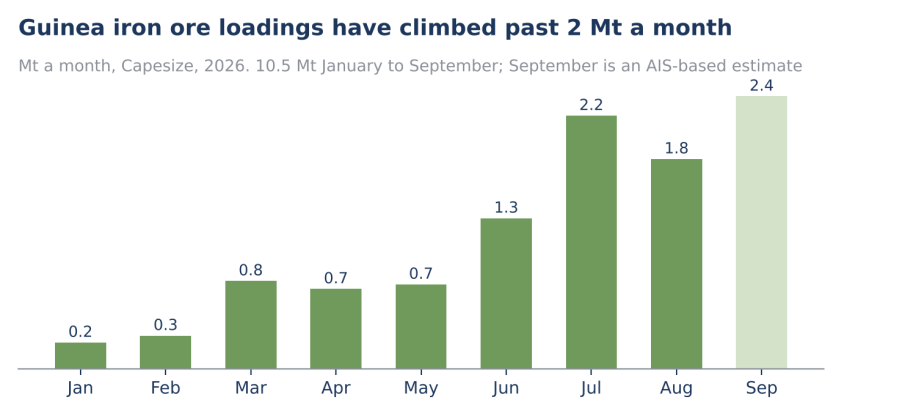
Simandou loadings passed 2 Mt a month by July. At that pace 2026 looks to be tracking close to our forecast of about 17 Mt for the year. July and August figures are partly AIS-based and may be revised.
Exports by commodity
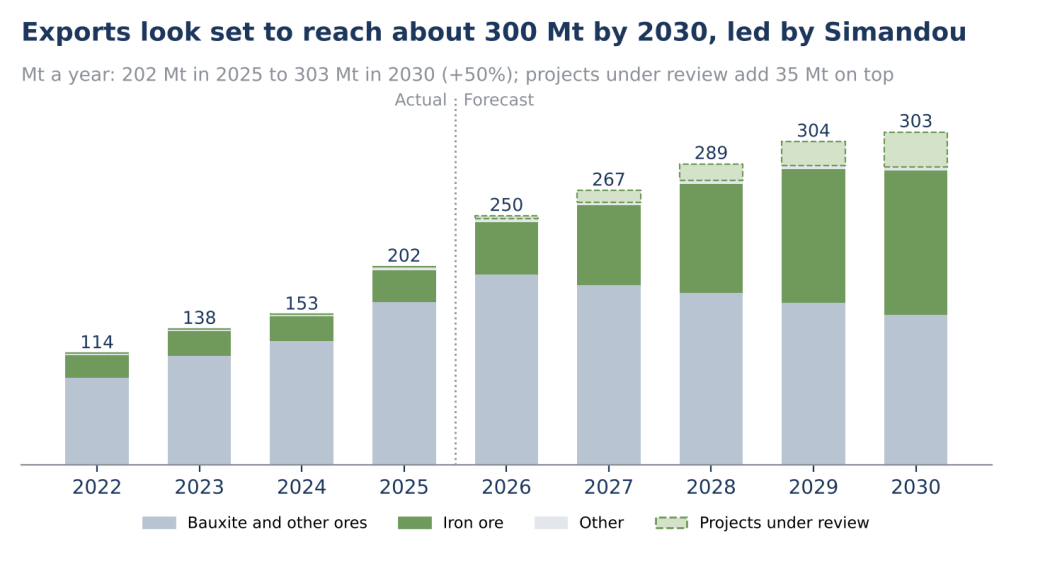
Our forecast has Guinea iron ore at about 112 Mt by 2030, which more than offsets an easing in bauxite. Iron ore's share of the region's exports rises from about 16% in 2025 to nearly half by 2030. The pale segments show projects under review, which sit on top of the forecast.
Bauxite built the base
Guinea bauxite accounts for most of the growth so far. On our country data, Guinea's dry bulk exports rose from 89 Mt in 2022 to 166 Mt in 2025, almost all of it bauxite and around 90% of it on Capesizes. Guinea's mines ministry reported bauxite exports up 25% to 182.8 Mt in 2025, on its own basis.
China takes the bulk of it. Chinese bauxite imports reached 121.1 Mt in the first half of 2026, up 17.1% year on year, with Guinea supplying between 15.8 Mt and 19.6 Mt a month from April to June. Imports have been running well ahead of Chinese aluminium output, which we read partly as stockbuilding against policy risk in Guinea.
Our forecast has Guinea's bauxite exports peaking near 194 Mt in 2026 and easing to about 153 Mt by 2030, in line with the government's moves to curb exports and build local alumina refining.
Iron ore takes over
Simandou is the turning point. The first ore was railed to port in October 2025, and the first cargo of nearly 200,000 tonnes reached Majishan in China on 17 January 2026. Chinese partners hold 75% of a project rated at 120 Mt a year. Our forecast has Guinea's iron ore exports at 45 Mt in 2027, 75 Mt in 2028 and about 112 Mt by 2030, close to its rated capacity and all of it on Capesizes.
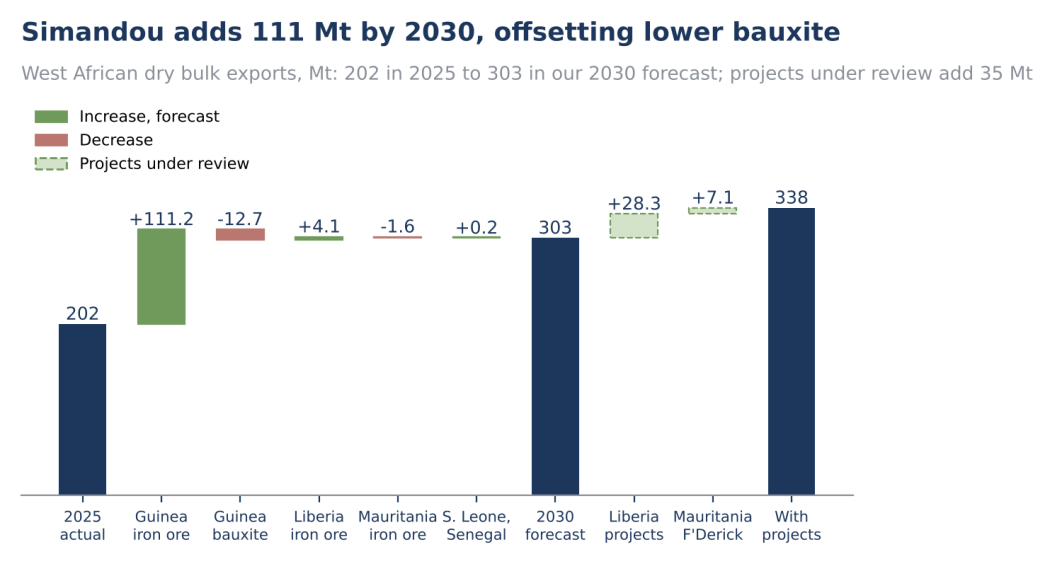
Liberia and Mauritania are steadier. Our forecast holds Liberian iron ore near 12 Mt a year and Mauritania near 11 Mt, with expansions in both under review.
Projects under review
We are reviewing three iron ore expansions for our next forecast round: ArcelorMittal's move from 5 Mt to 20 Mt a year in Liberia, Ivanhoe Atlantic's Kon Kweni ore from Guinea railed to the Liberian port of Buchanan, and SNIM's F'Derick project in Mauritania. Together they could add around 35 Mt a year by 2030, shown separately in the charts.
| Project | In forecast, 2030 (Mt) | Under review, 2030 (Mt) | Path under review |
|---|---|---|---|
| ArcelorMittal, Liberia | 12 | 20 | 15 Mt in 2026, 20 Mt a year from 2027 |
| Kon Kweni, via Buchanan | 0 | 20 | 2 Mt in 2027, 5 Mt in 2028, phase 2 from 2029 |
| SNIM F'Derick, Mauritania | 11 | 18 | 13 Mt in 2027, rising 2 Mt a year |
The Liberian forecast figure covers all of the country's exports. Also on our watch list: Simandou's final step up to its 120 Mt rating, a planned Port Loko bauxite operation in Sierra Leone, Cameroon's Minim-Martap bauxite in Central Africa, and a proposed 1,400 km railway from iron ore deposits in the Central African Republic to Kribi in Cameroon, which looks unlikely to ship before 2030.
Round voyages: long, one-way and ballast-heavy
The distance is what makes West Africa matter for ships. A Capesize loading in Guinea for China sails about 10,700 nm laden, around 37 days at 12 knots. There is almost no Capesize cargo going back the other way, so the ship returns in ballast, another 34 days or so. With about six days in port, a round voyage takes around 78 days, so each ship completes only 4.6 round voyages a year.
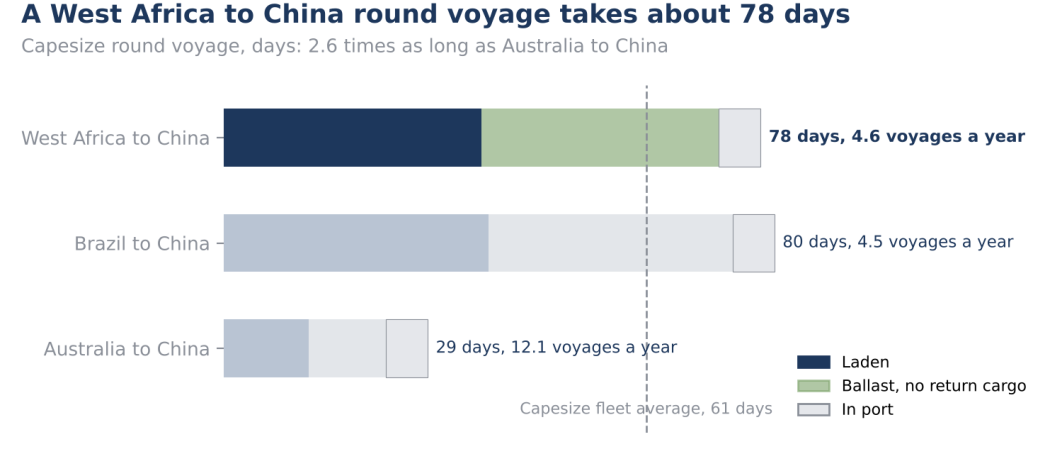
Brazil to China has a similar profile, while an Australia to China round voyage takes around 30 days, under 40% of the time. Each tonne from West Africa therefore ties up roughly 2.6 times as much ship time as a tonne from Australia.
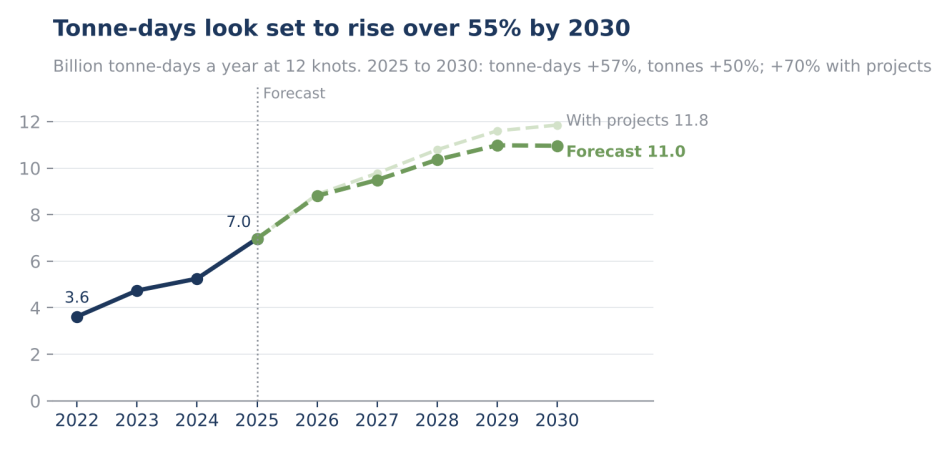
In ship terms, we estimate West African Capesize cargoes needed around 210 ships in 2025. On our forecast that rises to around 330 by 2030, about 16% of today's fleet of roughly 2,050 Capesizes. Moving the same 273 Mt of Capesize cargo (the Capesize share of the 2030 total) from Australia would take about 125. Tonne-days rise 57% between 2025 and 2030, faster than tonnes (+50%), as longer-haul iron ore replaces bauxite. Liberia's tonnes are split between Panamax and Supramax ships, a modest lift for the midsize fleet.
Risks and our view
- Bauxite, the most uncertain call. The risk runs both ways. China has been importing bauxite well ahead of its aluminium output, and further stockbuilding against supply risk in Guinea could keep shipments above our forecast. Against that, Guinea has said it will cut exports and is reported to be weighing a cap of about 150 Mt. Our forecast already has bauxite easing, but a hard cap would bring that decline forward.
- Project timing. Simandou's ramp and the projects under review depend on rail, port and approvals running to plan. Kon Kweni still needs environmental approvals.
- Weather. Heavy rain in July to September cut Guinea's Q3 2025 bauxite shipments 19% below their first-half pace. A similar dip looks likely each year.
- Dedicated tonnage. China Merchants has signed a 25-year Simandou haulage deal backed by six 344,000 dwt ore carriers for 2029 and 2030. Part of the new haul may stay out of the open Capesize market.
- Displacement. Our forecast already trims Australian iron ore exports as Simandou displaces some of them in China. Simandou is a higher-grade ore, Chinese partners hold 75% of the project, and China has made clear it wants to rely less on Australian supply. If displacement goes further than we assume, total tonnes would grow less, but tonne-days would still rise, since a West African round voyage is roughly 2.6 times as long.
Our view: West Africa looks to be one of the most important sources of Capesize demand growth to 2030, and the shift from bauxite to iron ore makes that growth less dependent on one commodity and one buyer's stockbuilding.
Behind the analysis
The same country export data and forecasting framework are available to your team, on your own commodities and routes.
Book a demoData note
Tradeviews dry bulk export data by loading country (Guinea, Sierra Leone, Liberia, Mauritania and Senegal): actual to 2025, Tradeviews forecast from 2026. Projects under review are our estimates. January to August figures use monthly data. Tonne-days at 12 knots; round voyages assume 12 knots laden, 13 knots in ballast, six days in port and 180,000 tonne cargoes. News: Tradeviews news archive.
For information only; not investment advice.